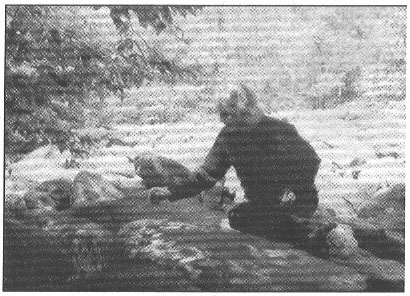
 Using a stone the size of a baseball, the Catbird judiciously tapped a boulder the size of an office safe and was stunned to hear it chime like Big Ben.
"It's hollow!" she cried.
"No," I responded with the smug assurance of one who already has checked things out on the internet. "It's not hollow; it's just full of iron and other hard minerals."
"I won't go into what you're full of," she responded, sweetly, "but I still say it's hollow. It rings like a bell!"
In the vast field of boulders that give Ringing Rocks Park in Bucks County its name, they all ring like bells, with tones ranging from high ping to sonorous bong. If one could assemble an orchestra of percussionists, each placed at a boulder tuned to a note on the diatonic scale, one might stage a very literal rock concert. Whatever the score, "heavy metal" would lie at its heart, because despite the Catbird's opinion to the contrary, it really is the iron content that makes them ring.
If any geomorphologist knows where all those great stones came from, I haven't found him or her. There is no mountain nearby down which they might have rolled. No remnant of a primordial volcanic furnace in which their igneous bodies might have been forged when the world was young is evident to the layman's eye. They simply lie there, as though cast like eldrich runes from the hand of a giant, in the heart of a 65-acre park owned by Bucks County just 9 miles south of Easton.
The area they occupy might have been a lake bed at some point in time. It covers roughly two acres, surrounded by the forested terrain typical of the rest of Pennsylvania, but for all that one can detect of their origin, they might have come from outer space. We're told another identical phenomenon is located just outside Pottstown. In all our travels, we've never encountered anything quite like it.
Ringing Rocks Park, however, is not easy to find -- especially if you're approaching it from the north, where no signs announce its presence.
|
| The catbird plays rock music in Ringing Rocks Park in Bucks County. |
| Photo by Ken Clark |
Ringing Rocks Park, which also boasts a beautiful waterfall and lots of lovely flora and fauna, also is rich in the lore of magic and mystery. Compasses are said to spin madly in the vicinity of the boulder field (we didn't have one handy, so we can't prove that). Seekers of the paranormal periodically go there in search of ley lines, harmonic convergences and other New Age phenomena, and in the early days, when William Penn owned the whole state, witches and practitioners of the Pennsylvania "Deutsch" healing art of "powwow" are said to have congregated in the area. Only the stones know for sure, and while they may sing, they're not talking.
The Ringing Rocks alone are worth the trip, but the village of New Hope, just 24 miles further down River Road, as the locals call Route 32, does a lot to enhance the experience. Navigating River Road in the spring is like driving through a primeval forest with foliage so thick that it envelops the narrow road, turning it into a tunnel of verdant green. The blaze of color that comes with autumn is said to be equally breath-taking.
We made our trip in the family sedan, rather than the motorhome. That proved to be a wise choice because the road, flanked on the east by the lazy old Delaware River and decorated with fieldstone houses predating the American Revolution, is so narrow that in places, stop signs warn of "one-way" traffic across stone bridges. A canal with a "towpath" where mule-drawn barges once moved goods to market parallels the road. The path now is the purview of joggers and bikers, but tourists visiting New Hope still can take barge excursions along the river.
New Hope, itself, is a tiny art colony with a permanent population of 2,252, but Larry Weikel, director of the visitors' center, said that figure explodes in summer months as up to 100,000 tourists jam the narrow old-world streets and battle, frequently in vain, for the handful of parking spaces available.
Between New Hope and Lambertville, its virtual twin just across the river in New Jersey, more than 200 art galleries, antique stores, boutiques, New Age emporia and craft shops peddle their wares in side-by-side competition.
Little has changed in two centuries, but Weikel, said new residents, fleeing the stress of New York and Philadelphia, are moving in at an unprecedented rate.
"There has been a 62 percent increase in new housing since the 1990 census, and a population increase of 61 percent," he said. "Three developers have established one big housing development and people are still moving in. It's a big increase, but we're still a major art colony. Last year, American Style magazine named New Hope number five in the nation as an art destination for the second year in a row, after Cape Cod, New York, Santa Fe and San Francisco."
The county covers 640 square miles, and the population crush apparently is not restricted to New Hope. According to David Hanauer, who runs a website on the area (www-personal.umich.edu/~hanauer/tour/bucks_tour.html), "suburban sprawl" is devouring much of the once pastoral region.
"In 1945," he writes, "Bucks County was 67 per cent farmland and farms occupied over 260,000 acres. As of 1996, the farmland was down to only 18 per cent of the county, representing 70,000 acres. And the number of farmland (acres) is still disappearing at an alarming rate."
But a lot of beauty and a ton of nostalgia remain. Bucks County has been home to more celebrities of the arts per capita, perhaps, than any other region outside New York or Hollywood. Authors Pearl S. Buck, James Michener, Philip Roth and Jonathan Weiner all lived there at one time or another. So did anthropologist Margaret Mead, and artists Daniel Garver and Edward Hicks, who painted the famous "Peaceable Kingdom."
On the darker side, Abbie Hoffman, one of the famed "Chicago Seven" and founder of the "Yippie" movement in flower children days, took his own life there, and Jessica Savitch, NBC's "Golden Girl" of 1980s network news anchors, died there in a tragic accident.
New Hope boasts the Bucks County Playhouse, a great white barn on the river where productions of Broadway musicals are staged. The playhouse has the same oweners as the Pocono Playhouse, and many of the productions travel from one stage to the other.
Lambertville features great fieldstone churches, stately hotels and the original home of Jim Marshall, the guy who migrated west and picked up that first gold nugget at Sutter's Mill in California, setting off the gold rush of 1849.
Stone bridges, built in the Roman style in the 18th and 19th centuries, span streams and gullies on both sides of the river and just a few miles down the river lies Washington Crossing State Park. That's the spot where, on Christmas Day in 1776, General George and his rag-tag army of 2,400 men and 18 canon crossed the Delaware to ambush the Hessian mercenaries at Trenton and turn the tide of battle in the Revolutionary War.
In New Hope, the New Hope and Ivyland Railroad, with its classic cupolaed station house, takes tourists on scenic runs along the Delaware, at one point crossing the trestle where, in 1914, scenes for the silent movie melodrama, "The Perils of Pauline," were shot. The railroad once served as the primary rail link between New York and Philadelphia.
In fact, New Hope had its origin as a transportation center. The town, founded in 1681, initially was named Wells' Ferry, after the proprietor of the ferry boat that transferred passengers and cargo across the river to New Jersey. When Wells sold it to another entrepreneur named Coriel, he renamed it Coriel's Ferry. Then, in 1789, the whole town went up in flames, as towns were wont to do in those days. Benjamin Parry, a wealthy miller and the town's leading citizen, lost both his grist mills, but he rebuilt them and named them the "New Hope" mills because, he said, they offered new hope to the dejected, burned-out townspeople. The name stuck and so did the people. Parry's mansion now serves as a museum featuring 11 rooms decorated in styles ranging from 1775 to 1900.
"Whew," said the Catbird. "That's a lot of history packed into one small, sleepy looking little village."
"It's not so sleepy in the summertime," I replied. "With all the tourists jamming these narrow streets, and all those new residents moving in, they have a real people problem."
New Hope has solved part of its people problem by sprouting enough hotels, inns and restaurants to house and feed a small army. We stopped for lunch at Mimi's, an eatery featuring an open-air dining patio. No sooner were we seated than the place filled up with 50 or 60 college kids from the nearby campuses of Princeton and Rutgers. Most of them, we were told, were seeking summer jobs in the flourishing tourist trade, though many obviously were there because, in addition to its other amenities, New Hope is a marvelous party town.
"I think I see the problem," the Catbird said as she prepared to take knife and fork to a veggieburger far too fat to handle by hand. "It's said of New York City, 'It's a great place to visit, but I wouldn't want to live there.' Well, In the case of New Hope, it's a great place to visit, but I would want to live there."
So, apparently, does everybody, and that has a downside. We left hoping the growing horde of fans won't eventually love the little village on the Delaware to death.