"We used to have deer and turkey coming through here. It was a beautiful view," he said. "Now what do you see? Destruction."
Believe it or not, while the first quote about Bucks County above is from 2006 the second quote is from over half a century ago (1952). Even then Bucks County was facing the challenge of sprawl, but is has not been until recently that much at all has been done about it. Where did suburban sprawl come from? The answer is complex, and the story takes us to various places around the country, including Michigan, New York, and even Bucks County itself.Many of the old residents are unnerved by the expanding metropolis in their midst. One township commissioner lamented recently: "We had a nice quiet place here. No problems, no headaches. Now you wake up each morning wondering what's going to break loose next."

|
|
Henry Ford
|
The story starts in Michigan. In the early part of the 20th century Henry Ford began manufacturing cars in southeastern Michigan.
 With his application of the assembly-line process to automobile manufacturing, he was able to mass produce cars that were affordable to the average person. The Model T, first introduced in 1908, created a huge explosion in car sales with over 16.5 million eventually sold. No other car was to sell as well as the model T until 1972 when the Volkswagon Beetle surpassed the model T's sales record. The success of the model T spurred the automobile revolution that allowed people, for the first time, to easily move out of cities and invade the suburbs, traditionally small farming towns.
There is a story that when Henry Ford visited the Mercer Museum in Doylestown, he offered to purchase the entire museum and move it back to Dearborn, Michigan where he was creating his own historical museum. Henry Mercer, so the story goes, refused, wishing to keep the historical treasure right here in Bucks County. In the end, though, Ford was still able to take much away from Bucks County (namely, the peace and serenity of the farming communities that had long existed there) with his invention, the mass-produced automobile.

|
|
|
With the boom in automobile production came an equal need for better roads and highways. The original Office of Road Inquiry, founded in 1893 with an annual budget of $10,000 evolved in 1967 to become the Federal Highway Administration, with a budget today of over $26 billion! Back in 1916, President Woodrow Wilson created the Federal-aid highway program, which allowed for federal funding to assist in road building projects. Thus the groundwork was being laid for roads to leave the cities and invade the pastoral country side. (Doylestown, PA was made much more accesible to Philadelphia in 1963 when US Route 611 was widened from Doylestown to Montgomery County, which had already been widened to Philadelphia).
The population boom after World War II further encouraged people to leave cities which, combined with the automobile and the beginnings of a national highway system, set the stage for the final big step in the beginnings of suburban sprawl: the sprawling housing subdivision. Ironically, Bucks County was to play an early part in what was to eventually become a scourge of the nation.

|
|
|
But before Bucks County is brought into the story, it is first necessary to mention what happened out on an inconspicous piece of farmland on Long Island. It was there that the beginnings of suburban sprawl were about to take shape, and the man behind the big change was William J. Levitt. William Levitt did for houses what Henry Ford did for automobiles. He developed a system for mass production that was affordable to the masses. Levitt's first sprawling creation started in Long Island in 1947 as 2000 monotonously similar-looking homes and developed by 1951 into a sprawling complex of over 17,000 homes. This complex still serves as an archetype for sprawl.

|

|
|
Levittown, NY, before the sprawl
|
Levittown, NY, after the sprawl
|

|
|
|
With the success of the Long Island sprawl known as Levittown, William Levitt looked elsewhere to build other profitable housing developments. And one of those places was right in Bucks County, PA. It is ironic that even back in the 1950's sprawl was becoming a problem in Bucks County, albeit not necessarily recognized as a problem. Perhaps back then few realized how relentless and overwhelming it would become. But the warning signs were there, especially as Levitt's new town in the county was described at the time as "the fastest-growing city in the world." An article in a 1952 Reader's Digest describes the situation quite well, and ironically it applies with great precision to the same troubles occuring today. But interestingly, the article portrays this growth in a rather positive manner, a major change from how such growth is usually described today. Certainly it is no longer a "miracle":
This miracle is a routine spectacle for the first residents of Levittown, the fastest-growing city in the world. Four thousand homes will be completed by the end of 1952; in the next two years 12,000 more. In ten short years it is expected to be the size of Norfolk, Va., one of the 50 largest cities in the country. Its creators, Levitt & Sons, have singlehandedly built a metropolis overnight.
The article goes on to describe other interesting points about the development at Levittown and, although it is from fifty years ago, it still remains applicable to the issues going on today. Farmers are still having a hard time making ends meet and the lure of quick, easy money from a developer is difficult to resist compared to the many years of toiling over the land for virtually no profit at all. Compare the quote from the Reader's Digest article to a modern day quote from an article in the Daily Intelligencer:
|
|
It is interesting to note that even back in the 1950s there were those rare people who were willing to stand up against the developers and try to protect the farmland from the bulldozer. Back then, though, they were portrayed in a rather negative manner (e.g. "crotchety old farmer", "run-down acres") by the press:
Probably the only man untouched by the surging interplay of forces between the new city and the once-quiescent countryside is a crotchety old farmer with 70 run-down acres on the edge of Levittown. His property has long been sought by Levitt's agents. But the old man keeps putting them off. "I grow the finest patch of weeds in Bucks County," he tells them. "No hard feelings, mister, but I just aim to sit here." And there--despite the fastest-growing city in the world--he sits.
As sad as it is, little has changed in all that time. The question is, fifty years after the beginnings of sprawl in Bucks County, where are we at today? Levittown is still there, and a historical marker now marks the location with the words:
|
This fully planned, six-home style residential community was conceived by the builder William J. Levitt. The first family moved in, June 23, 1952. When completed in 1957, Levittown containted 17,311 homes on 5,750 acres, designed for a population of 70,000. It expanded on the pattern set by Levittown, N.Y. (built 1947-51) and was a landmark in the development of suburban housing in the United States. |
| "The culture of advertising...eroded our capacity to distinguish between the truths and lies. And not even in more terms, but on the practical level. You could label a house 'traditional' and someone would accept it, even if all the traditional relationships between the house and its surrounding were obliterated. You could name a housing development Forest Knoll Acres even if there was no forest and no knoll, and the customers would line up with their checkbooks open." --Quoted from The Geography of Nowhere, by James Howard Kunstler, (c) 1993 |

|
|---|
|
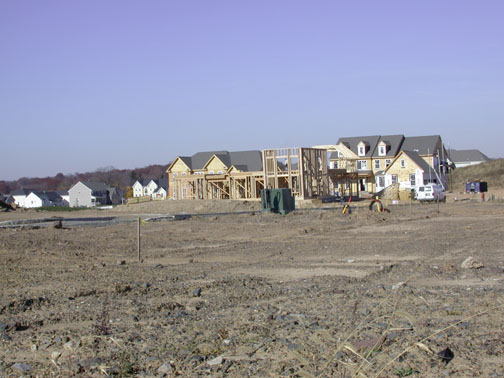
What does suburban sprawl look like today? This example, from a Doylestown Township booklet, demonstrates the nature of the sprawl. The fertile fields are rapidly being converted into home after home after home. You won't find this on the cover of any Bucks County advertisement, but this is how Bucks should truly be represented today.
|
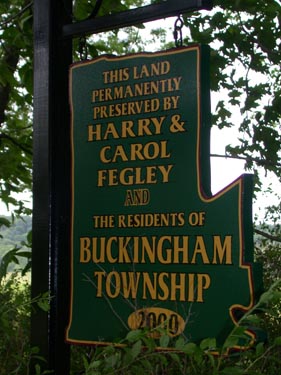
Although the county now looks vastly different today from the past, all hope is not lost (yet). While slow to action, the residents of Bucks County have become much more aware of the environmental onslaught that is occuring around them. Organizations now exist to try to help preserve land. Fundraisers take place to increase awareness and raise money for land preservation. Townships have been purchasing land to try to stave off at least a little of the development. And residents have recently become more willing to depart with their money in the form of increased taxes in order to help purchase land.
 |
Several options exist to preserve land. Land can be purchased outright from farmers, but this is often an expensive venture and not much land can reasonably be saved in this manner. For example, Warrington recently spent about $2,000,000 to purchase "42 acres of open space in an area of Warrington where developers are vying for every acre," as was described in a February 1999 article in the Daily Intelligencer.
Another option is to buy the development rights to the land, known as a conservation easement. Once a farmer sells his or her development rights, he or she is still allowed to live on and farm the land and even sell the land. But the right to ever develop it is lost in the sale. This is a more cost-effective approach but it is still too costly to preserve much land. (A 48-acre tract of farmland was preserved in Solebury in 1999 at a cost of $384,000 for the development rights. That comes out to about $8,000 per acre).
 |
 |

Photo by Mitch Bunkin |
The new Bucks County landscape.
|
Townships in Pennsylvania face the difficulty of dealing with arcane laws which favor developers. Such laws include ones that require townships, no matter of what size, to provide for housing of every income level. This allows for developers to sue townships for changes in the zoning laws, known as "substantiative challenges" or "curative amendments." Often these lawsuits result in the zoning rules being re-written in favor of the developers, allowing them to build high-density developments in areas that were not intended to contain such housing.
 |
| "[A] memo from the builders' trade association detailed a series of changes it would like to see made to the highly popular programs. One policy point went so far as to call for ending state funding of farmland preservation, and others advocated changes local officials said would cripple preservation programs." --Quoted from the Daily Intelligencer, 2002 |
 |
| "We're losing not only our agricultural and natural heritage, but the very reason why people want to move here and stay here and raise their children here in Bucks County." --Kevin Corrigan of Buckingham, 2002, running for state representative. Quoted in Daily Intelligencer |
 |
| "There is little sense of having arrived anywhere, because everyplace looks like noplace in particular."" --Quoted from The Geography of Nowhere, by James Howard Kunstler, (c) 1993 |

Photo by Richard Hanauer
|
Without open space, hot air balloons will have nowhere to land |
| "The cost to society in terms of money spent building and maintaining roads...is titanic. The least understood cost--although probably the most keenly felt--has been the sacrifice of a sense of place: the idea that people and things exist in some sort of continuity, that we belong to the world physically and chronologically, and that we know where we are." --Quoted from The Geography of Nowhere, by James Howard Kunstler, (c) 1993 |
| "It is less expensive, in the long term, to preserve land than to permit it to be developed." --Bucks County Commissioner Mike Fitzpatrick, Quoted from the Daily Intelligencer, 2003 |

Photo by Richard Hanauer
|
As open space disappears, wild turkeys such as this one will becoming increasingly rare |
Buying land for preservation is actually inexpensive. In fact, compared to all of the costs associated with the concurrent growth it's a bargain, but relatively little is being spent on saving the remaining land. As opposed to the $100 million expected to pay for two new schools (mentioned above) to accomodate the new students from all of the growth, only $60 million has been allocated by the county to preserve open space.
 |
Five cents. This is the daily cost to the average Bucks County homeowner for land preservation. Shouldn't we be spending more? |
It has been estimated that the average Bucks County home owner will pay about $20 per year in additional taxes to pay for this open space preservation program--that comes out to about 5 cents per day! How much would you be willing to spend to avoid increased traffic, a decreased quality of life, and a loss of the natural beauty of the area? More than a nickel per day? As money runs out for the original open space program, a new open space referendum will be put forward in the near future, and it will be up to the voters--the citizens of Bucks County--to decide if they are willing to spend more money to preserve the area and, if so, how much can be spent. Any investment now will surely pay off later. Bucks County preserved its 100th farm as of September 2006 (the program started in 1989), but there were still 60 farms still on the waiting list to be purchased and preserved. One thing is certain, if the county doesn't grab the land, the developers surely will. So it is up to the citizens to decide the future of the remaining open space: preservation or destruction through construction.
Time is crucial. The battles must be fought on the local, state, and even national levels. The forces faced are formidable, but if everyone does their part to stop the endless development, some of the beautiful landscapes that are disappearing before our eyes may yet be preserved. It is the will of the people, not the developers, that should prevail. We all must act now and do more than ever to make a difference. For once the land is gone so will have gone the singular quaintness of this beautiful Bucks County.

|
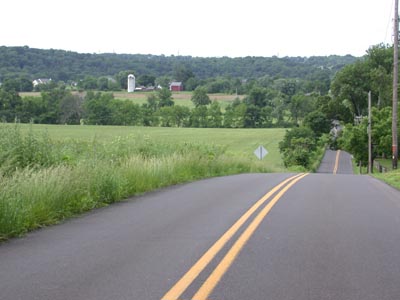
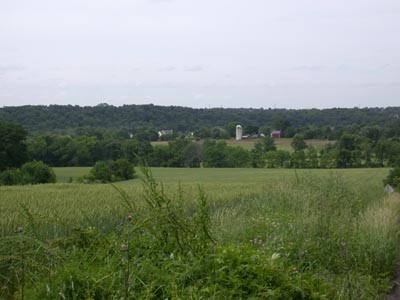
The residents of Bucks County have a choice. Either they can sit back and let the remaining farm land become housing developments or they can fight to preserve what remains of the county's open space.
|
"I absolutely don't want this. I like the county and I want it to stay that way," said one resident who wouldn't give her name. "Traffic is difficult..already. They can't tell me traffic won't increase."
-Daily Intelligencer, March 6, 2003.
"There is nothing in which the birds differ more from man than the way in which they can build and yet leave a landscape as it was before."
-Robert Lynd"When land is developed, it ceases being land. It becomes covered, sealed, its own grave."
-Joy Williams, 'One Acre', Harper's MagazineAcross the rural northeast, where I live, the countryside is littered with new houses. It was good farmland until recently. On every county road, every unpaved lane, every former cowpath, stand new houses, and each one is somebody's version of the American Dream. Most are simple raised ranches based on tried-and-true formulas--plans conceived originally in the 1950s, not rethoughts since then, and sold ten thousand times over.
These housing "products" represent a triumph of mass merchandising over regional building traditions, of salesmanship over civilization. You can be sure the same houses have been built along a highway strip outside Fresno, California, at the edge of a swamp in Pahokee, Florida, and on the blizzard-blown fringes of St. Could, Minnesota. They might be anywhere. The places they stand are just different versions of nowhere, because these houses exists in no specific relation to anything except the road and the power cable. Electric lighting has reduced the windows to lame gestures. Tradition becomes prepackaged as screw-on aluminum shutters, vinyl clapboards, perhaps a phony cupola on the roof ridge, or a plastic pediment over the door--tribue, in sad vestiges, to a lost past from which nearly all connections have ben severed. There they sit on their one- or two- or half-acre parcels of land--the scruffy lawns littered with the jetsam of a consumerist religion (broken tricycles, junk cars, town plastic wading pools)--these dwellings of a proud and sovereign people. If the ordinary house of our time seems like a joke, remember that it expresses the spirit of our age. The question then is: what kind of joke represents the spirit of our age? And the answer is: a joke on ourselves.
-James Howard Kunstler, 'The Geography of Nowhere', (c) 2003
 |
 |
 |
 |  |
 |  |
 |  |
 | |
 |  |
 |  |
 |  |
 |  |
 |  |
 |
 In August 2007, a new effort was initiatied to save more open space. Ten years after voters approved a $59 million bond to preserve open space, money was running out. Yet there was still much land to be protected.
Over 70 percent of voters approved the first referendum in 1997, and even though there were some vocal opponents there was about the same approval rate by voters for the second round of funding.
Is $87 million a lot of money? Not really. Just imagine what will happen if more land is developed and even one more school has to be built to accomodate the new students. The relatively recent Central Bucks South High School cost about $84 million to build (and that was just the cost to build it, not to hire all of the teachers and run the place!). Just imagine if that $84 had gone to preserving land instead. We would also have less congestion, more open space, and saved money in the end.
The report for the Open Space Task Force II can be found here.
A website to "Save the Patterson Farm" in Lower Makefield Township.
A website created to fight sprawl in upper Bucks County: ECO-Bucks.
A pamphlet entitled "Save Our Open Spaces", published by the PennEnvironment organization in 2003, which includes several photographs from this online tour.
The official Buckingham, PA website related to land preservation
A link to The Heritage Conservancy, a Doylestown organization dedicated to land preservation.
A website related to efforts to save "Historic Dolington Village" from the destructive forces of developers.
The Congress for a New Urbanism web site as well as the more local Association for the New Urbanism in Pennsylvania.
Information about Masters Degrees To Build A Sustainable Future
Sources and credits for information used on this web page can be found here.